When Is the Best Time for Stargazing at the Pinnacles?
The best nights for Pinnacles stargazing: new and full moon dates, sunset and full-dark times by month to October 2027, and how tour start times move.
Book a night close to the new moon. On 9 December 2026, 8 January 2027 and 6 February 2027 the moon is new (Perth Observatory), so it is out of the evening sky; around the full moons of 24 November and 24 December 2026 and 22 January 2027, moonlight hides the fainter stars. Any month works for the sunset, because the tours move their start with it. Autopia Tours’ From Perth: Pinnacles Sunset and Stargazing Tour with Dinner is US$137 a person (checked November 2026).
Free cancellation runs until 24 hours before, so a date booked now can still be cancelled for a full refund if the forecast turns.
Sunset, full dark and the moon, month by month
| Month | Sunset | Sky fully dark | New moon | Full moon |
|---|---|---|---|---|
| November 2026 (15th) | 18:53 | 20:25 | 9 November | 24 November |
| December 2026 (1st) | 19:07 | 20:42 | 9 December | 24 December |
| January 2027 (1st) | 19:25 | 21:02 | 8 January | 22 January |
| February 2027 (1st) | 19:18 | 20:48 | 6 February | 21 February |
| March 2027 (1st) | 18:53 | 20:16 | 8 March | 22 March |
| April 2027 (1st) | 18:16 | 19:36 | 7 April | 21 April |
| May 2027 (1st) | 17:43 | 19:05 | 6 May | 20 May |
| June 2027 (1st) | 17:26 | 18:51 | 5 June | 19 June |
| July 2027 (1st) | 17:29 | 18:54 | 4 July | 18 July |
| August 2027 (1st) | 17:45 | 19:08 | 2 August | 17 August |
| September 2027 (1st) | 18:03 | 19:23 | 1 and 30 September | 16 September |
| October 2027 (1st) | 18:20 | 19:41 | 29 October | 15 October |
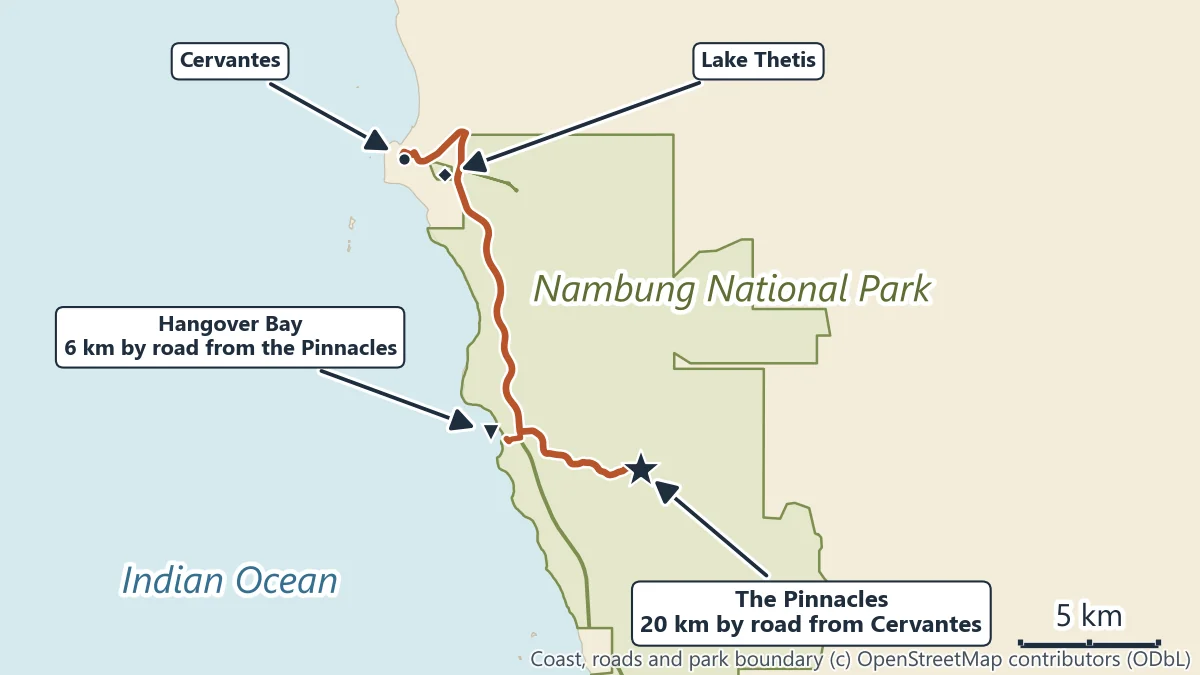
Western Australian time (UTC+8; Western Australia has no daylight saving). Sunset and full dark are computed for the Pinnacles; Perth Observatory’s published Perth tables give the same times to the minute, and the Pinnacles run about a minute later than Perth. “Fully dark” is the end of astronomical twilight. Moon phases from Perth Observatory’s tables for 2026 and 2027.
The earliest sunset is in June, at about 17:25, and the latest in early January, at 19:25. The sky is fully dark 80 to 100 minutes after the sun goes down, in every month.
Why the moon matters more than the month
A bright moon is the one thing in the sky that hides the stars. In the days around a new moon the evening sky has little or no moon; from first quarter to full moon it is up in the evening and getting brighter; after full moon it rises later each night. The first quarters before the next three full moons fall on 17 November and 17 December 2026 and 16 January 2027 (Perth Observatory).
Guests notice. One who booked Autopia Tours’ evening “on a moon-less night” in March 2026 wrote that the sky cleared and “put on an amazing show”. Another, in April 2026, advised going “when not a full moon as able to see more stars in less moonlight”. A full moon is not a wasted night: Autopia Tours’ guests in April and September 2026 wrote about seeing the Moon up close through the telescope. But for the Milky Way, pick the dark week.
November to February: a late dark
From mid-November to February the sun sets after 18:50 and the sky is not fully dark until about 20:20 at the earliest and as late as 21:02 on 1 January. The tours keep the same order all year (sunset, dinner, stars), so in these months the stargazing starts later in the evening. One of Autopia Tours’ guests in late October 2026 would have liked to stay longer, because “it was not all dark when we left the desert and therefore could not see the Milky Way”. From April to September the sky is fully dark by about 19:40, earlier in June and July.
The Parks and Wildlife Service describes December to March as usually hot and dry, and says most of Nambung National Park’s 540 mm of rain a year falls between May and September. So the evenings are warm and dry from December to March, and dark earlier but wetter from May to September. Cloudy nights has what each tour does when the weather turns.
Start times move with the sunset
Autopia Tours started at 1:30 PM on 14 November 2026 and at 2:00 PM on 8 December 2026 and 12 January 2027, the dates we read. The availability calendar shows the start time for each day.
Lumineer Adventure Tours started at 1:15 PM on 14 November 2026 and 1:30 PM on 8 December 2026 and 12 January 2027, the dates we read. Pickup times come by text, email or WhatsApp the evening before.
Australian Pinnacle Tours started at 2:00 PM on Wednesday 9 December 2026 and Wednesday 13 January 2027, the dates we read; Tuesday 8 December 2026 and Tuesday 12 January 2027 were not on sale. Check that your night is on sale before you plan around a new moon.
Which night to book
If your dates are free, take an evening between the last quarter and about three days after the new moon, when the evening sky has no moon or only a thin crescent that sets soon after the sun: 1 to 12 December 2026, 31 December 2026 to 11 January 2027, or 29 January to 9 February 2027 (last quarters on 1 December 2026, 31 December 2026 and 29 January 2027, Perth Observatory). If your dates are fixed, book anyway. The sunset at the Pinnacles is the same on any clear evening, and the bright stars and the planets show even with a half moon up.
What you can see from the Pinnacles shows the sky on the new-moon nights of December, April and July.
More from Perth
Pinnacles Tours with Open Dates
Sunset tours, day trips and other tours from Perth with live availability. Where each starts, what it includes and the cancellation terms are shown before you book.
Pick a Dark Night
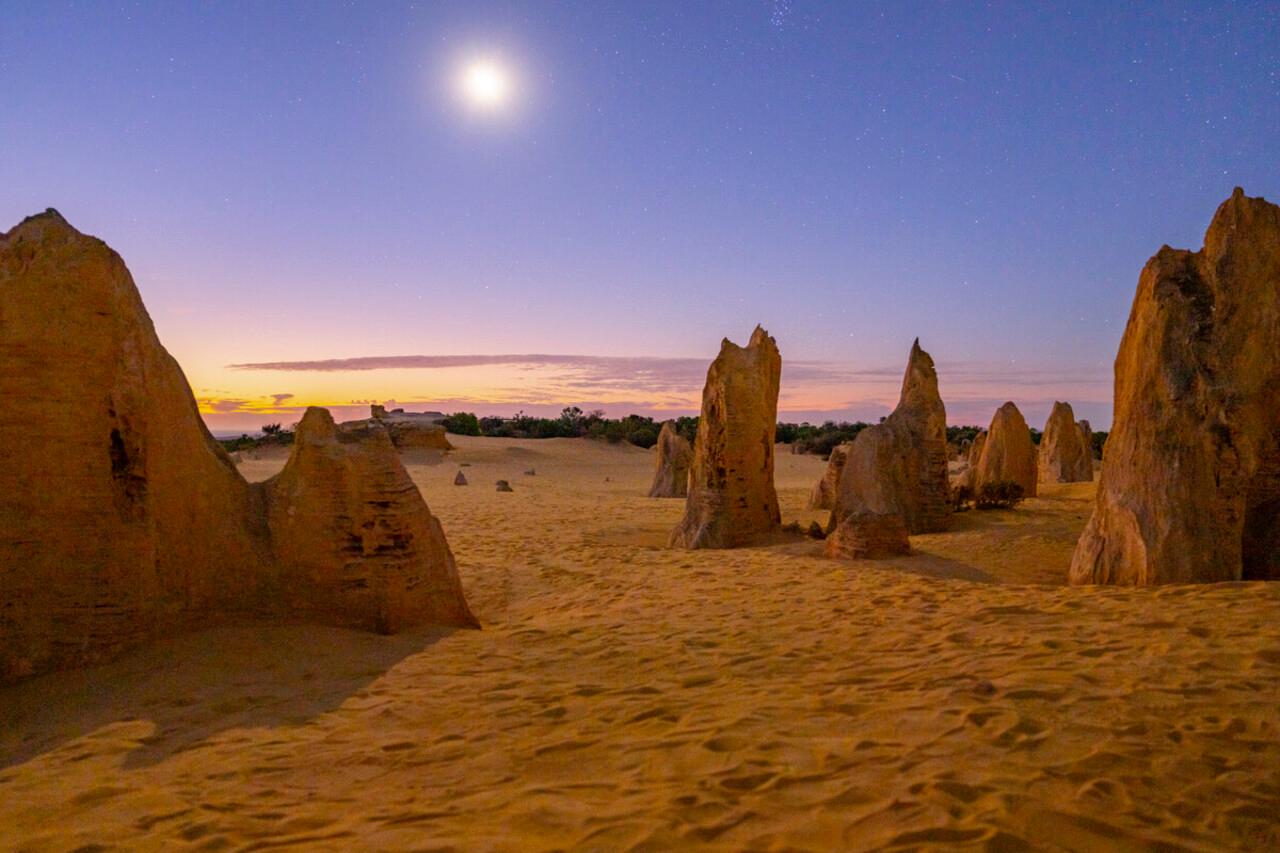
Autopia Tours' nine-hour evening from Perth: the Pinnacles at sunset, a picnic dinner with a glass of wine and a telescope, weather permitting.
See dates