What Can You See in the Night Sky at the Pinnacles?
The night sky over the Pinnacles in computed star charts: the Magellanic Clouds and Saturn in December, the Southern Cross in April, the Milky Way in July.
On a clear, moonless evening the sky over the Pinnacles holds the Southern Cross, both Magellanic Clouds and, in the middle of the year, the bright centre of the Milky Way. On 9 December 2026 Saturn is high in the north-west as well. The charts below are computed for the Pinnacles on the new-moon nights of December, April and July. On Autopia Tours’ From Perth: Pinnacles Sunset and Stargazing Tour with Dinner, from US$137 a person (checked November 2026), the guide points out the sky and sets up a telescope, weather permitting.
Each chart shows the sky at the end of twilight on that month’s new-moon night, the earliest the sky is fully dark. The tours stargaze after sunset and dinner, so on the night you may be looking at this sky a little earlier, in the last of the twilight.
December: the Magellanic Clouds, Orion and Saturn

Facing south on a December evening, the two Magellanic Clouds stand high in the sky. They are small galaxies next to our own, and on a moonless night away from towns they look like two pale patches of cloud that do not move. Canopus, the second-brightest star in the night sky, is to their left, and Sirius, the brightest, is round to the east with Orion above it. The Southern Cross is low, sitting right on the southern horizon.

Turn round to face north and Saturn is the steady, slightly yellow light high in the sky towards the north-west. Through a telescope its rings show: several of Lumineer Adventure Tours' guests wrote about seeing them between November 2025 and October 2026. Orion is in the north-east, upside down to anyone from the northern hemisphere, with Rigel above Betelgeuse.
April: the Southern Cross climbs

By April the Southern Cross has climbed into the south-eastern sky, with the two Pointers, Rigil Kentaurus and Hadar, just below it. The Milky Way runs up through the Cross towards Canopus, and the Magellanic Clouds have swung round to the south-south-west, the Small Cloud lower. The sky is fully dark by 19:36 on 1 April 2027, earlier than in December.
July: the centre of the Milky Way

In July the brightest part of the Milky Way, its centre, is up in the east as soon as it is dark, between Scorpius and the Teapot shape of Sagittarius. The Southern Cross and the Pointers are high in the south, well above the southern horizon. Full dark comes early, at 18:54 on 1 July 2027. A guest on Autopia Tours’ evening in July 2026 wrote that the Milky Way was visible to the naked eye.
What the telescope adds
The charts show what your eyes get. A telescope brings in the Moon’s surface and the planets. Autopia Tours brings one telescope, used when the weather permits, and guests who wrote in April and September 2026 saw the Moon and Venus through it; one in October 2026 had Scorpius and Sagittarius pointed out on a cloudy night. Lumineer Adventure Tours brings telescopes and astro binoculars and sets out to show planets, star clusters, nebulas and the Moon; its guests have written about Saturn’s rings and Jupiter. Australian Pinnacle Tours' evening includes no telescope.
For a sky with the Milky Way at its darkest, book close to a new moon: the best nights for stargazing lists them to October 2027. For the planets and the Moon through the eyepiece, any clear night does.
See dates for the telescope evening
Is the stargazing any good? has what guests did not like about it, too.
More from Perth
Pinnacles Tours with Open Dates
Sunset tours, day trips and other tours from Perth with live availability. Where each starts, what it includes and the cancellation terms are shown before you book.
See It Through a Telescope
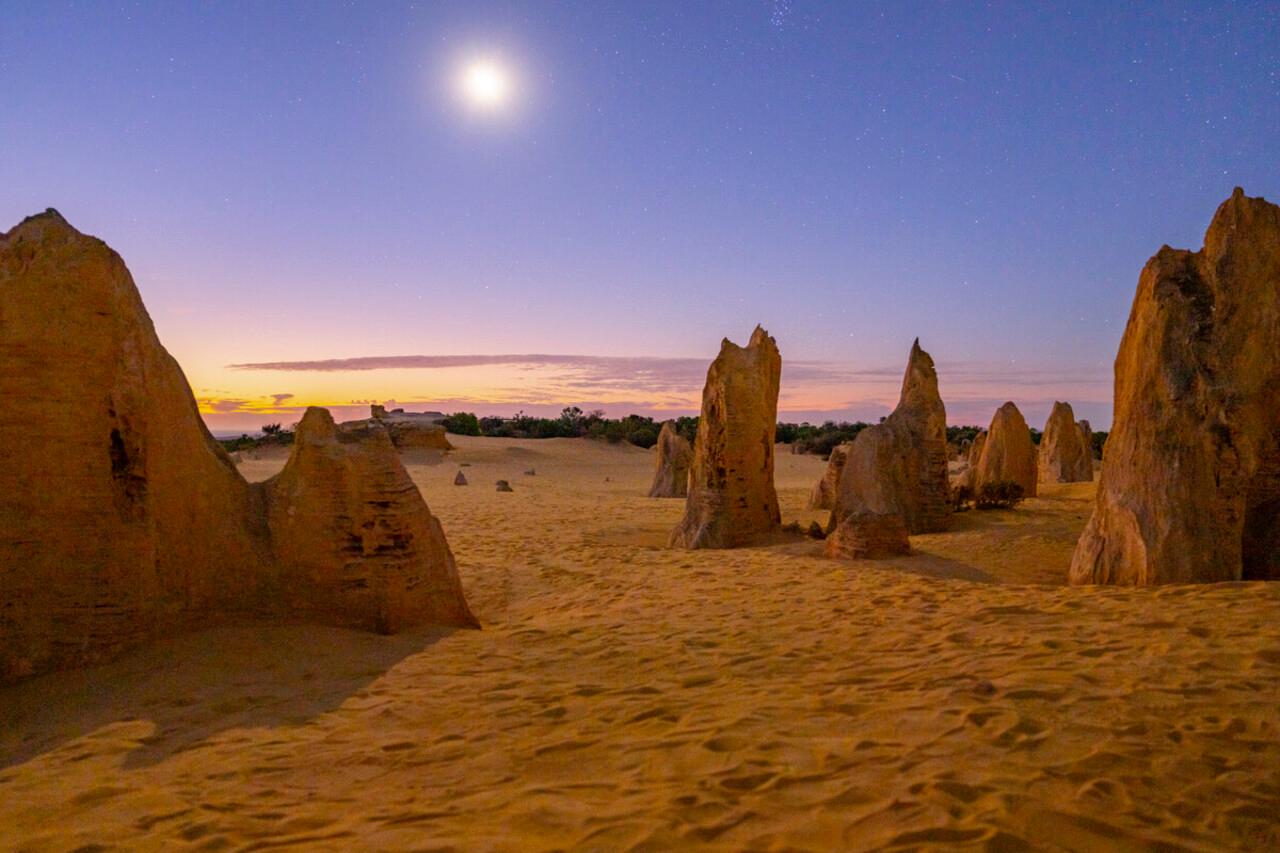
Autopia Tours' evening from Perth: the Pinnacles at sunset, a picnic dinner, then the guide's tour of the sky and a telescope, weather permitting.
See dates